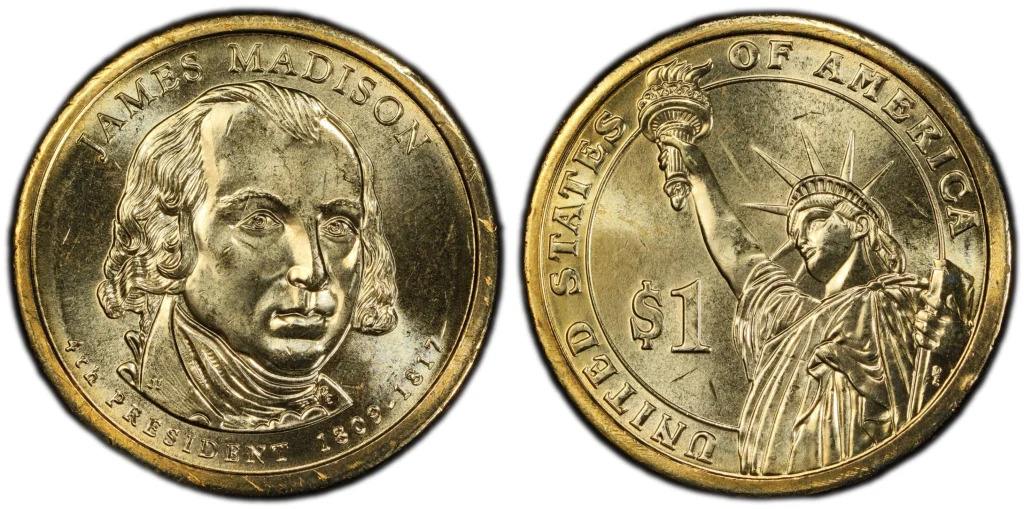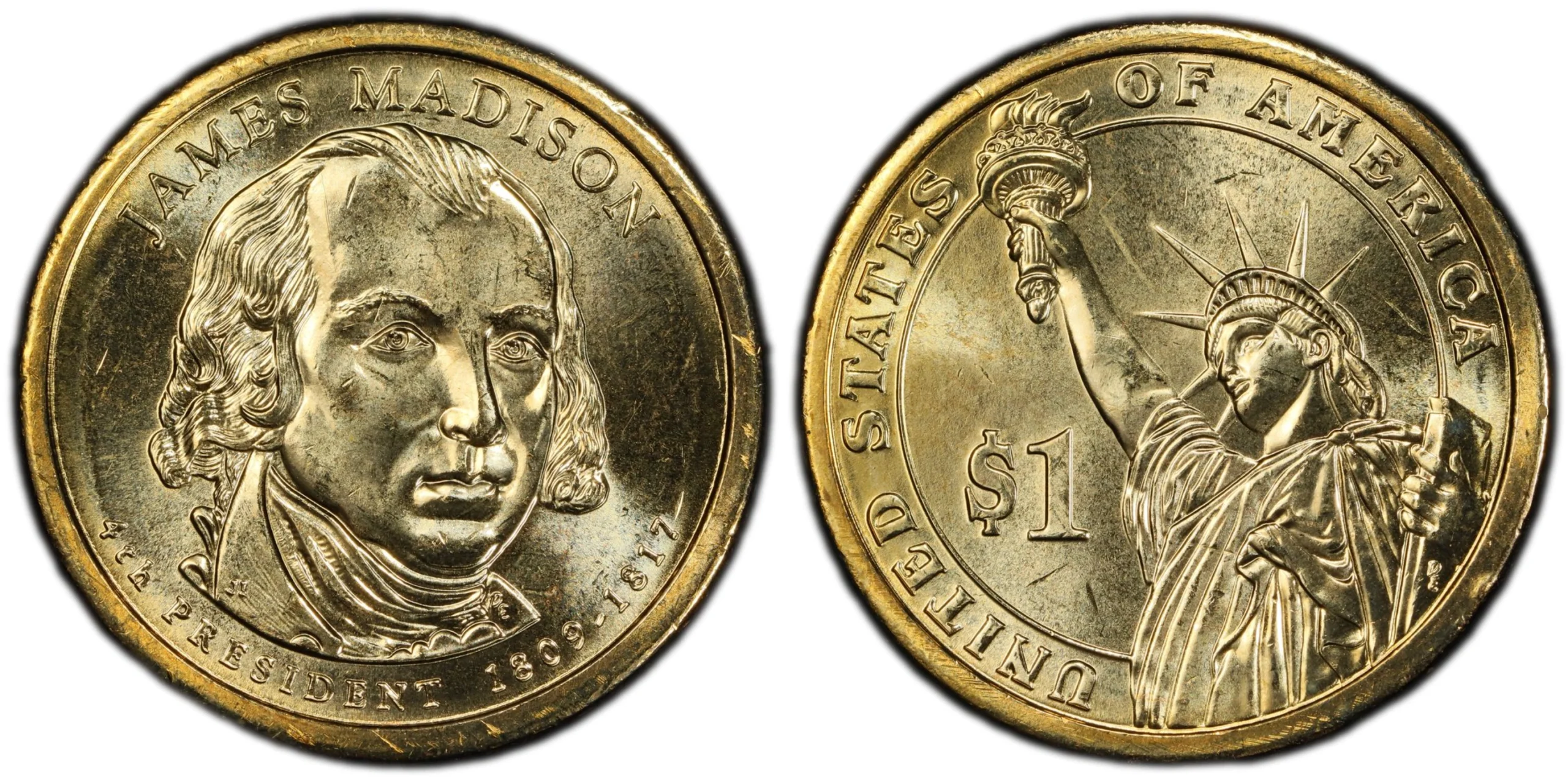
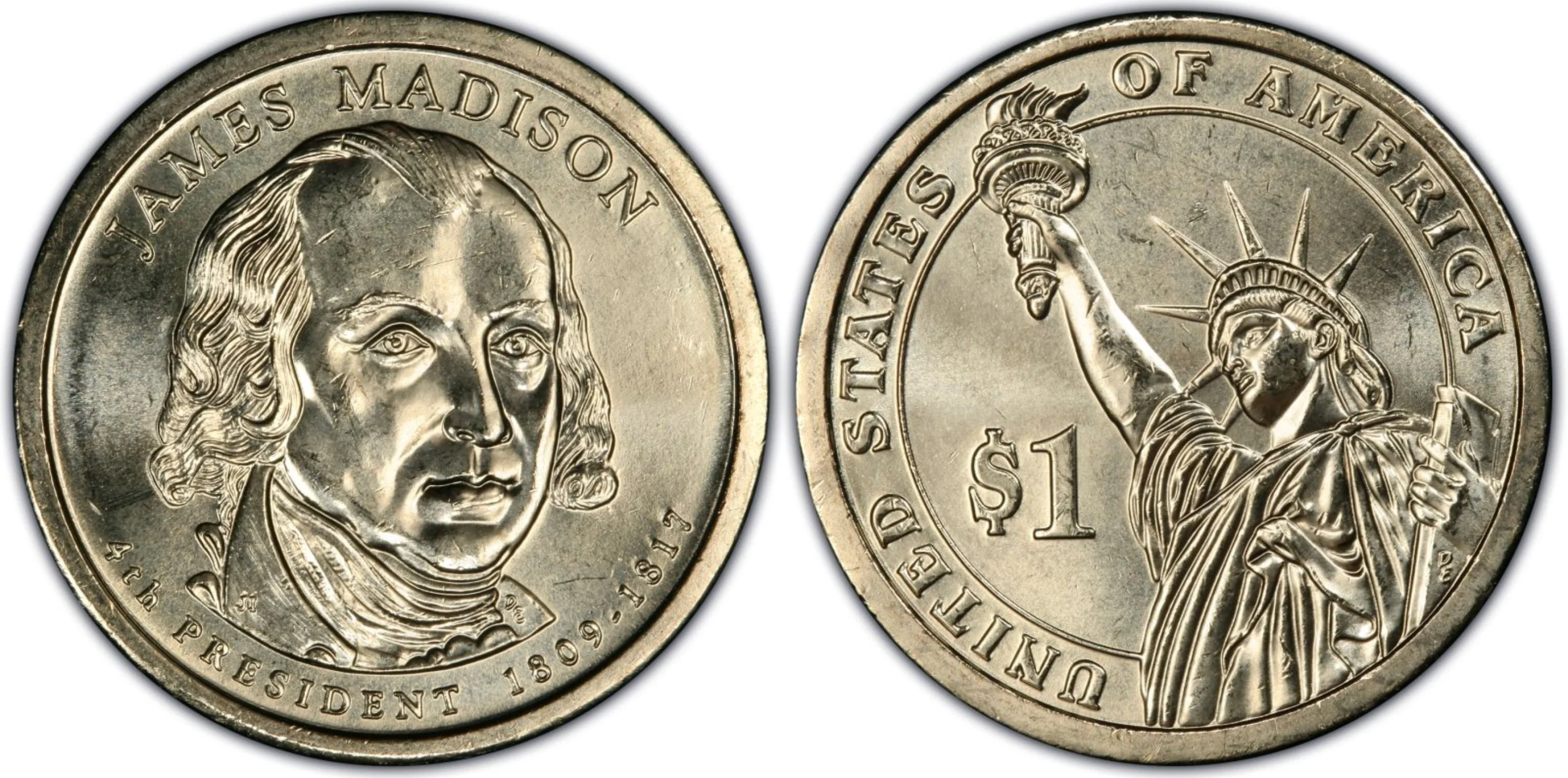
In many cases, the James Madison $1 coin value is equal to its face value – $1, but with rare defects, it can be worth $60 or more dollars.
What Is a Standard 2007 Madison Dollar Worth?
The ordinary item costs $1. Look for item characteristics below for clear identification.
| Diameter | 26.50 mm |
| Weight | 8.10 g |
| Metal | 88.5% Copper |
| Edge | Lettered |
Circulated vs. Uncirculated Rolls
The value chart above highlights a significant pricing gap between single coins pulled from pocket change and intact 25-coin rolls. This split comes down to two primary numismatic forces: condition preservation and error hunting potential.
Because these coins lack precious metal content, general wear instantly strips away any collector surface. A coin that shows bag marks, oil stains from hands, or localized rim dings is worth exactly one dollar. Local coin shops will not pay a bonus for individual loose pieces because they cannot resell them for profit.
| Type | Condition | Value |
| Loose Coin | Circulated | $1.00 |
| Loose Coin | Choice BU | $2.00–$4.50 |
| 25-Coin Roll | Uncirculated | $35.00–$60.00 |
2007-S Proof and Silver Sets
The standard 2007-S proof dollar features sharp, mirror-like fields and frosted details. The Mint also included this design in the 2007 Presidential Dollar Silver Proof Set. Because these silver sets feature precious metal content, the bonus increases.
- These base-metal proof pieces retail for $3 to $5.
- Individual silver proof examples trade for $8 to $12.
Elite Grades That Command Big Money
Under the grading system, standard coins become high-value assets if they achieve near-flawless grades from services such as PCGS or NGC.
Why MS-67 and MS-68 Tier Barriers Explode in Price
Because the Mint dumped millions of these dollars into large canvas bags during production, the coins slammed into each other. This rough handling left:
- Bag marks
- Microscopic nicks
- Scrapes on Madison’s cheeks and fields
- MS-65 Value $3
- MS-67 Value $15–$30
- MS-68 value $100–$300
You must differentiate standard business strikes from Special Mint Strikes. From 2005 to 2010, the Mint utilized a distinct sandblasted die technique for coins included in official Uncirculated Coin Sets.
James Madison Error Coins
Mechanical failures during the distinct edge-lettering process created the most sought-after varieties in the entire Presidential Dollar series. These errors bypass standard price ceilings.
The “Godless” Dollar: Missing Edge Lettering Prices
During 2007 production, full baskets of struck Madison dollars completely bypassed the edge-lettering machine. These coins left the mint with perfectly smooth edges. They lack the date, the mint mark, and the national motto. Collectors immediately dubbed these pieces “Godless Dollars.”
Value $30–$60
Double Edge Lettering and Inverted Edge Varieties
Other mechanical blunders produced alternative edge errors. Double edge lettering occurs when a coin passes through the edge-inking machine twice, which creates overlapping or ghostly text.
Inverted edge lettering occurs when workers feed coins into the machine upside down relative to the obverse. The Mint considered this a normal production variance rather than an error, so inverted edges carry zero premium.
Value $20–$40+
2026 James Madison $1 Coin Value Chart
The reference grid below compares current retail market pricing against actual auction realizations for the James Madison dollar.
| Issue | Value |
| 2007 Philadelphia | $1.00–$3.00 |
| 2007 Denver | $1.00–$3.00 |
| 2007 San Francisco Proof | – |
| Missing Edge Lettering (Error) | $15.00–$35.00 |
Where to Get Full Market Value
When you decide to liquidate your Madison dollars, you must choose your sales venue carefully to avoid losing your profit margins to transaction costs.
Why Local Coin Shops Pay Wholesale Prices
- Dealers offer lower wholesale prices.
- They must cover store overhead.
- They pay $20 for $40 items.
- They reject common one-dollar coins.
If you take a handful of raw, uncirculated Madison dollars or a basic smooth-edge error to a brick-and-mortar coin shop, the dealer will likely offer a wholesale price.
Dealers must account for their:
- Storefront overhead
- Rent
- Utilities
- Resale timelines
For a missing edge lettering error worth $40 retail, a dealer will offer $20 to $25.
PCGS & NGC Grading Services
To capture full market guide value, you must bypass the middleman. Online auction platforms allow you to sell directly to specialized error collectors.
Submitting a standard James Madison dollar coin to PCGS or NGC requires a financial strategy. Because both institutions demand an annual membership fee plus fixed transaction costs, sending a single, common coin is a losing proposition.
Upfront Expenses – you must purchase an annual membership.
Value $25–$69
Per-Coin Fees – modern-tier coins (1965 to present).
Value $19–$22
Additional Costs – every separate invoice adds a $10 handling fee, plus round-trip shipping and mandatory insurance fees.
Value $30–$50
Special Designations for the Madison Dollar
When you look at the certification label on a graded Madison dollar, you will notice a “Position” designation. This tells you which way the edge lettering faces when the coin lies flat:
- Position A – the edge lettering reads normally when the obverse (Madison’s face) is facing up.
- Position B – the edge lettering reads normally when the reverse (Statue of Liberty) is facing up.
The Population Report Disconnect
If you are grading a 2007-S James Madison Proof coin from a collector proof set, the grading scale creates a stark market contrast. Data from major auction databases reveals a fascinating dynamic between the two services:
NGC Population Data – NGC has graded over 46,000 of the 2007-S Madison Proofs. Roughly 77 % of their population receives a Proof 69 Ultra Cameo grade, while about 22 % achieve a perfect Proof 70 Ultra Cameo.
PCGS Population Data – PCGS has graded fewer overall pieces, but their distribution is much stricter. They award 9.25 Proof 69 coins for every single perfect Proof 70.